
Keep your number. Test the call route before you commit.
We may earn a commission if you buy through links on this page. It never changes our order.
Key takeaways
- Forwarding routes calls; porting moves the number to another provider. Confirm account-level compatibility and charges.
- Test caller ID, busy/no-answer routing, transfers and rollback before changing a live business line.
- Voice routing does not establish SMS delivery or a completed calendar booking. Check those separately.
Choosing a receptionist and changing the route of your business phone calls are two separate decisions. Before buying a plan, ask whether the vendor can receive calls from your current carrier, what forwarding costs, which calls will be routed, and how to return them to your existing setup.
For a cautious first evaluation, consider forwarding only the calls you currently miss, if your phone service supports it. Porting moves the number to another provider; it is not just a different forwarding setting. Neither option should be changed on a live customer line without a plan for failed calls and a way back.
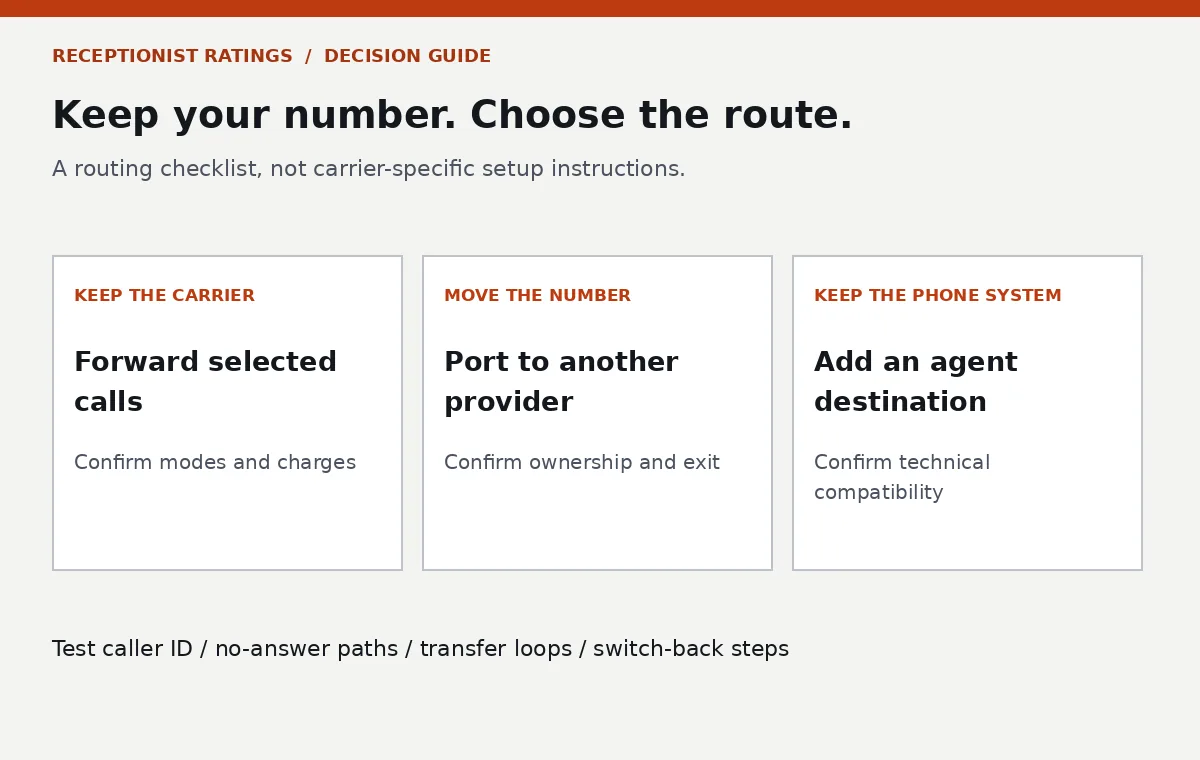
Pick the route for the problem you have
| Route | What changes | Useful evaluation case | Confirm before using it |
|---|---|---|---|
| All-call forwarding | Incoming voice calls are redirected to another number | Staff cannot answer, or you want the agent to be the first destination | How to switch it off; charges for forwarded and transferred minutes |
| No-answer or busy forwarding | The phone service sends selected unanswered or busy calls onward | Keep staff answering first and catch overflow | Supported triggers, ring timeout and whether carrier voicemail wins the race |
| Scheduled routing | The phone system routes by opening hours or a schedule | After-hours-only coverage | Time zone, holidays and manual overrides |
| Number port | The number moves to another provider | A later decision when the vendor's number ownership and exit terms are acceptable | Eligibility, account details, expected interruption, messaging migration and port-out process |
| Existing phone-system integration | The agent becomes a destination within your system | You need existing queues, extensions or routing rules to remain in charge | Compatibility, configuration ownership and responsibility when a call fails |
The existence of one route does not mean your carrier or vendor supports all of them. This is a decision checklist, not an instruction to enter a star code. Use the current documentation for the exact phone product and country on your account.
Three questions before starting a trial
Who controls the number? Know whose account holds your established business number and any new AI destination number. If you leave the vendor, how do you keep or release each number? Ask before a port, not after canceling. Do not cancel the old carrier account based only on a new vendor's signup confirmation.
Which plan supports the handoff? A low-cost answering plan may take a message or send a link but not transfer or book. The Marlie vs Rosie comparison shows why a plan-level check matters. Ask about transferred-minute billing as well as the subscription price.
What happens if nobody can answer? Write the desired result for a busy staff line, an unanswered transfer, a closed office and a vendor outage. Do not make the only fallback a number that forwards back to the AI. That can create a loop instead of reaching a person.
A six-call acceptance checklist
Use fictitious details, an agreed test window and a second phone. Get consent from anyone receiving transfers. A completed greeting is only the first check; inspect the destination and stored outcome too.
- Normal inquiry: call from a number the agent has not seen. Check that the recorded caller number is the actual caller, not the forwarding line.
- No answer: leave the main line unanswered. Confirm the expected routing activates before the old voicemail answers. Do not assume a particular number of rings is universal.
- Busy line: test the busy condition separately where supported. A no-answer test does not establish busy behavior.
- Human transfer: route to a destination that does not itself forward back to the agent. Answer once and let it go unanswered once. Check the fallback and caller experience.
- After hours: use a temporary test schedule, not a real false closing message left on the business line. Restore the schedule afterward.
- Switch back: the authorized account holder disables or reverses the test route and calls again to confirm the original destination works.
This is a proposed evaluation procedure, not a report that we ran these calls. We have not independently tested the products listed here.
Treat messaging and booking as separate systems
Forwarding voice calls is not evidence that texts move with them. Check where inbound SMS arrives and which number sends confirmations. Ask the vendor about any messaging registration and costs that apply to your business. Do not promise customers that they can text the existing number until you have verified delivery.
Similarly, hearing the agent offer an appointment is not proof it created one. Use a test calendar and inspect the event, time zone, address and duplicate handling. Where a workflow involves patient, financial or other sensitive information, ask about the applicable contract and privacy requirements before using real records. A HIPAA keyword mention is not a compliance determination.
Write the rollback card
Keep a short internal note with the current route, the new destination, the account holder who can reverse it, the vendor support contact and the exact steps from your carrier's own documentation. Record the original settings before changing them. Confirm who will watch for missed calls during the trial and who can stop it.
Do not store passwords or account PINs in that note. Do not publish your private routing numbers in a public review. Keep number ownership and cancellation terms with your business records, and confirm the number works after any change.
Choose a trial only after the route is clear
Use the call-volume calculator for modeled subscription cost, and the missed-call worksheet to test the economics with your own assumptions. Then compare specific plans and the tasks you need. Existing partner links below are commercial links, not proof of technical fit.
Check Marlie's setup and plans Check Rosie's setup and plans AFFILIATE50: 50% off your first month checked 2026-10-20 Check VoiceFleet's setup and plans
Sources and scope
Sources read November 21, 2026: docs.answeringagent.com/phone-numbers/forward-your-calls describes forwarding, a second-phone test and provider-specific instructions. nullstud.io/blog/ai-receptionist-phone-setup/ distinguishes forwarding, porting and existing-system connections, and calls out caller ID, transfer loops and number control. heyrosie.com/legal/terms discusses assigned/hosted numbers and post-termination number handling. Individual carrier compatibility, fees and cancellation terms remain unverified for your account. This guide is not carrier-specific or legal advice.
What do people ask most?
These are the questions we get most, answered from published vendor data.
Must I port my number to use an AI receptionist?
Not necessarily. Some services accept calls forwarded from your existing carrier or phone system. Confirm compatibility and charges for your number and plan before changing anything.
Is there one call-forwarding code that works everywhere?
No. Carrier, phone product, country and forwarding mode matter. Use the current instructions for your exact account. A wrong code can route calls incorrectly.
Will forwarding calls also move my texts?
Do not assume it will. Verify the messaging route separately, including the sender number, delivery and any registration the vendor requires.