
Is answering your missed calls worth the cost?
We may earn a commission if you buy through links on this page. It never changes our order.
Key takeaways
- A missed call is not automatically a lost sale. Count additional qualified opportunities, not spam or repeat callers.
- Use contribution after variable costs, not invoice revenue, when checking whether additional completed jobs cover the subscription.
- The worksheet uses your assumptions only. It does not predict recovered revenue or vendor performance.
A subscription pays for itself only if its additional contribution, after the costs of delivering those extra jobs, covers its incremental cost. A missed call is not automatically a lost customer. Start with your own call log, not a vendor's average recovered-revenue claim.
This worksheet deliberately starts blank. Enter a conservative estimate of the calls an answering service could genuinely handle in addition to your current process. Do not count calls you already return successfully, spam or repeat attempts as separate new opportunities.
Your break-even worksheet
All values are your assumptions. Nothing is saved or submitted. Rates are percentages, not vendor performance claims.
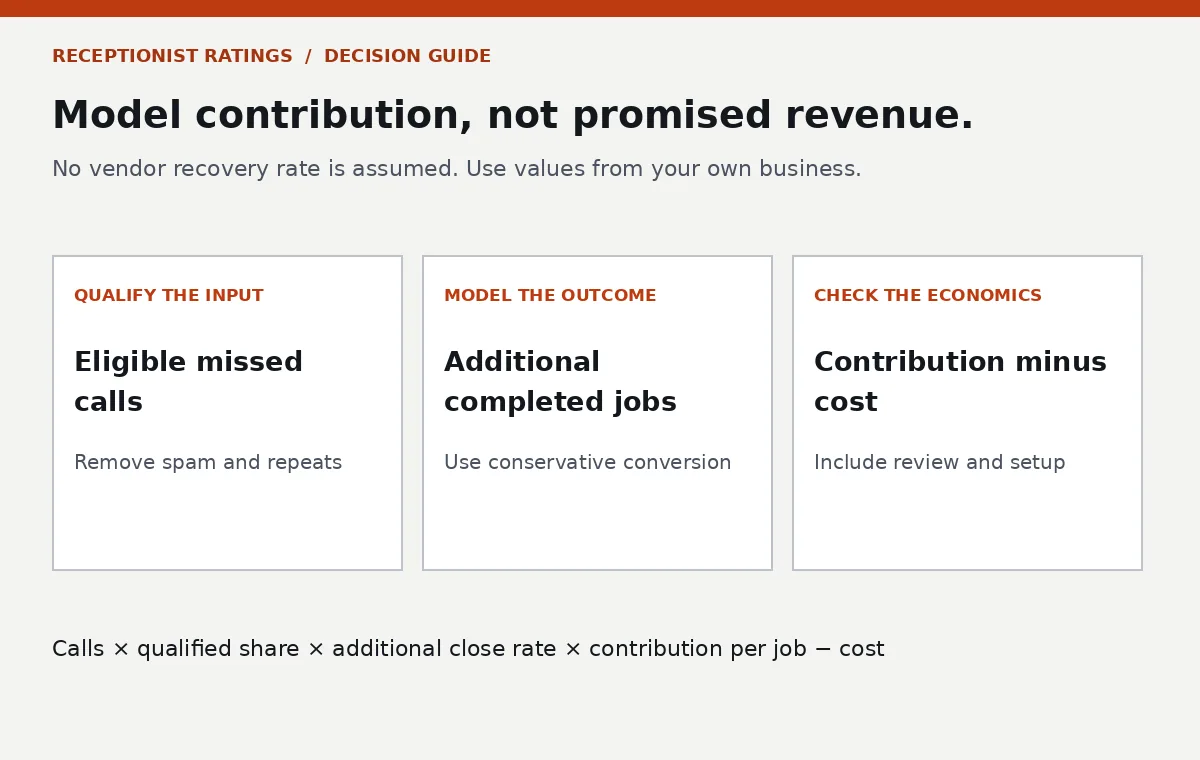
Enter all five values to calculate. Without JavaScript, use: calls × qualified share × additional close rate × contribution per job, minus monthly cost.
This is a planning model, not measured ROI. Contribution per job should be after variable delivery costs. Do not enter customer details.
A worked example, not a forecast
Suppose you have 40 eligible missed calls a month, half are qualified new inquiries, one in five of those inquiries becomes an additional completed job, and each job contributes $80 after variable costs. That is 40 × 50% × 20% = 4 additional jobs, or $320 in contribution. If your all-in incremental answering cost is $100, the modeled net contribution is $220.
Every figure in that example is hypothetical. It is not a claimed vendor result or a typical business outcome. If the answering system produces no additional completed jobs, the modeled benefit is zero and you still pay its cost. At $80 contribution per job and $100 total monthly cost, you need at least two additional completed jobs to cover that cost.
Count the calls that actually change the outcome
Take a representative period from your own phone records. Separate new business inquiries from customer-service calls, spam, wrong numbers and repeated attempts by the same person. Decide which hours or overflow conditions you would route. If the product only catches no-answer calls, do not use your whole monthly call count as its benefit base.
Then ask what would have happened without the service. If your staff would have returned a voicemail and won the job anyway, it is not an additional sale caused by automated answering. If an inquiry is outside your service area or needs a service you do not offer, answering it does not make it qualified.
A two-column log is enough to begin: the call's eventual outcome and whether the new answering route changed that outcome. Keep identifiable caller details out of any public worksheet or vendor demo. This calculator sends none of its inputs to a server; it calculates in this page and does not save them.
Put the full incremental cost in the model
Use the subscription you would really need, at the call volume the AI will receive. Add expected overage, required phone seats or numbers, relevant setup costs spread across your evaluation period, and extra staff time needed to review or fix calls. Deduct only expenses you will actually stop paying.
A low entry price is not necessarily the cost of booking appointments or transferring calls. For example, the Marlie vs Rosie comparison separates entry answering tiers from booking and transfer tiers. The call-volume calculator models published plan costs, not the full cost of every possible setup or workflow.
Stress-test the assumptions before subscribing
| Change one assumption | Why it matters | What to do |
|---|---|---|
| Half as many eligible missed calls | Seasonality or duplicate calls can inflate the initial count | Recalculate with a quieter month |
| A lower qualification rate | An agent may capture a call that was never a sales opportunity | Classify a sample manually |
| A lower additional close rate | A booking request is not a completed, paid job | Track cancellations and no-shows separately |
| Higher call length or more transfers | Usage charges can rise as the agent does more | Price the actual routed minutes and confirm transfer billing |
| More human review time | Correcting bad notes can offset time saved | Include review and follow-up costs |
If the decision only works under an optimistic scenario, do not label it a safe saving. A small, reversible after-hours or overflow trial may be more informative than forwarding every call at once. Get permission before recording people or sending them test calls, and check the rules that apply to your business.
Move from a worksheet to a shortlist
Write down the task that creates value: take a usable message, book the right appointment, or connect a caller to the right person. Then choose the minimum plan that supports it. Our matcher filters vendor mentions; it does not verify successful execution. Our three-tool shortlist compares modeled cost and unknowns at your volume.
Marlie, Rosie and VoiceFleet are examples already listed on this site, not a ranking of recovered revenue. Their tool pages show published pricing and the limits of our evidence. We have not completed independent test calls, so there is no performance or ROI score to compare.
Check Marlie Check Rosie AFFILIATE50: 50% off your first month checked 2026-10-20 Check VoiceFleet
Method and evidence
The arithmetic is: eligible missed calls × qualified share × additional close rate × contribution per completed job, minus incremental monthly cost. Break-even jobs round the cost divided by contribution per job upward. Zero and missing inputs are handled explicitly. The values are yours, not a dataset of business results.
Operational context: docs.answeringagent.com/phone-numbers/forward-your-calls and nullstud.io/blog/ai-receptionist-phone-setup/, read November 21, 2026. Those sources distinguish forwarding all calls from catching no-answer or busy calls. They do not establish the economic return for your business. See our number-routing guide before changing a live line.
What do people ask most?
These are the questions we get most, answered from published vendor data.
Does every missed call represent a lost sale?
No. Calls can be spam, repeat callers, existing customers or people outside your service area. Some callers leave a message or contact you another way. Count additional qualified opportunities, not all missed calls.
Should I use revenue or profit per job?
Use contribution after variable costs, not the full invoice value. Include additional callback or follow-up costs in the monthly cost input. The worksheet is a planning model, not accounting advice.
Does this worksheet predict an AI receptionist will pay for itself?
No. It calculates a hypothetical threshold from values you enter. It does not measure answer quality, lead quality, conversion or actual additional bookings.